verex
Market Groups & Probability-Sum Semantics
Goal: make the relationship between the markets inside one event a first-class, declared field — so Verex knows when outcome probabilities must sum to 100%, when they may not, and never renders one as the other.
Companion to negative-risk-markets.md. Neg-risk covers one group type (mutually exclusive). This doc covers the taxonomy around it — and the types where “sum = 100%” is simply the wrong question.
Why — the observed puzzle
Kalshi, “Will the Clarity Act become law?” — three markets under one event:
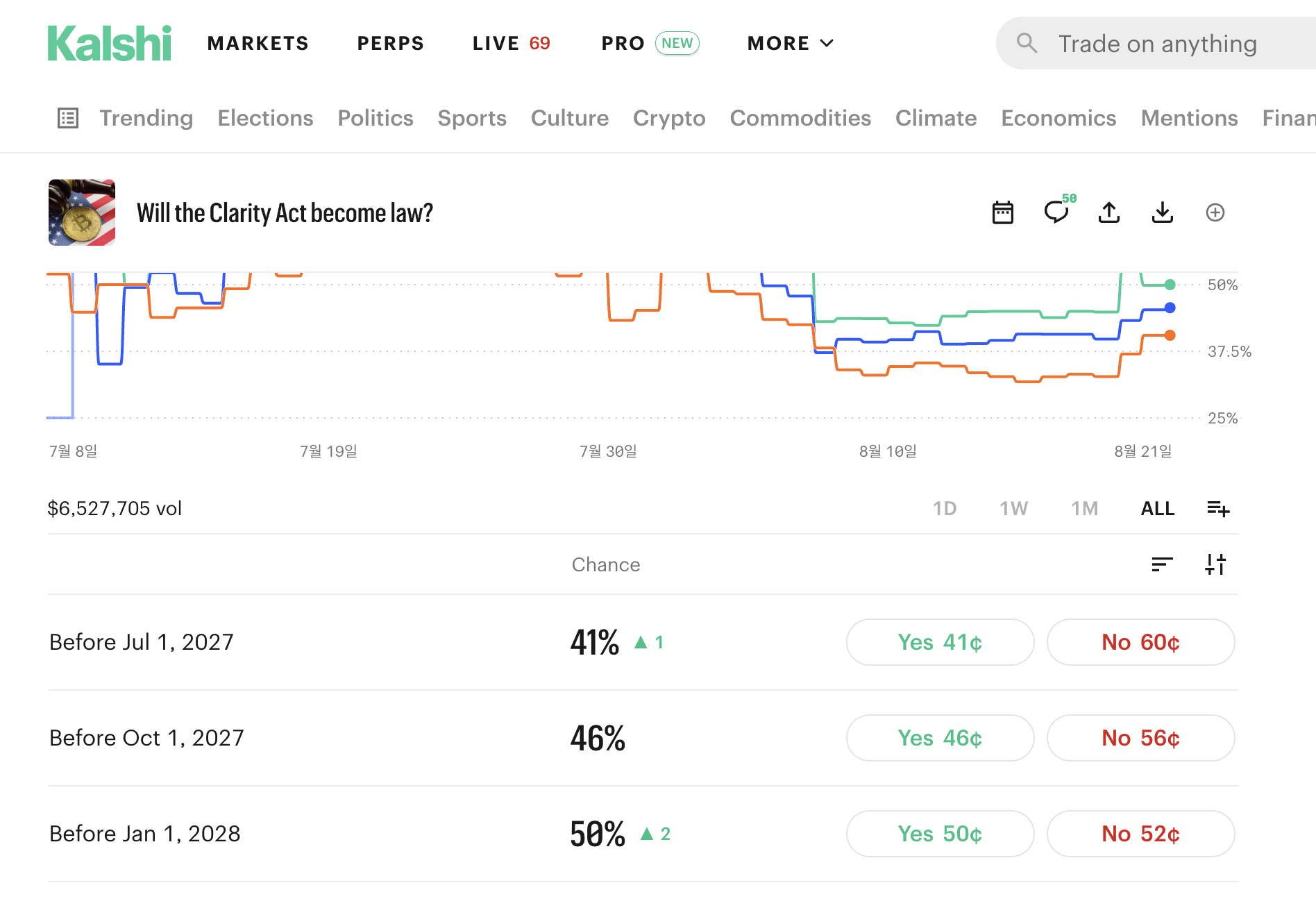
| Market | YES |
|---|---|
| Before Jul 1, 2027 | 41¢ |
| Before Oct 1, 2027 | 46¢ |
| Before Jan 1, 2028 | 50¢ |
| Sum | 137% |
This is not mispricing and not a display bug. The three markets are nested: “before Jul 2027” ⊂ “before Oct 2027” ⊂ “before Jan 2028”. They can all be YES at once (one early passage resolves all three), so there is nothing forcing them to sum to anything. The invariant that does apply here is monotonicity — 41 ≤ 46 ≤ 50 — and it holds.
The mistake to design against: assuming “outcomes under one event” ⇒ “probabilities partition 100%”. That only holds for one of the group types below.
Group taxonomy
| Group type | Example | Invariant | Σ YES | Neg-risk? |
|---|---|---|---|---|
| Binary — a single market | “Will X happen?” | YES + NO = 1 | 100% by construction (CTF split/merge) | n/a |
| Exclusive + exhaustive (categorical) | World Cup winner — 48 teams + “Other” | exactly one YES resolves | = 100% (arbitrage-enforced) | ✅ yes |
| Exclusive, non-exhaustive | a candidate shortlist with no “Other” | at most one YES resolves | ≤ 100% | partial |
| Directional / nested (Kalshi’s term) | the screenshot; TSA “1M+ / 2M+ / 3M+ check-ins” | monotone: A ⊂ B ⇒ P(A) ≤ P(B) | unbounded (137% above) | ❌ no |
| Independent / multi-winner | “Which phrases will the Fed chair say?” | none | = expected number of winners | ❌ no |
Only row 2 makes “normalize to 100%” a meaningful operation. Applying it to the screenshot would print 41/137 = 30% for a market the book says is 41% — a fabricated number.
What Kalshi actually does
- Two declared group kinds, with different collateral treatment:
- Mutually exclusive market groups — only one outcome can occur.
- Directional market groups — nested outcomes, where one implies another.
- Collateral return (
netting_enabled) exploits the group structure to cut margin:- Exclusive: No @ 60¢ on candidate A + No @ 70¢ on candidate B = $1.30 staked, but at least one pays $1 → the platform returns $1, so only $0.30 is actually at risk.
- Directional: Yes @ 80¢ on “1M+” + No @ 70¢ on “3M+” = $1.50 staked, guaranteed $1 back in the overlapping region → only $0.50 at risk.
- The flag is locked at the user’s first order in the event, not per-order.
- World Cup winner is an exclusive group with an “Other”/field bucket so the outcome set is exhaustive. Even so, the quoted numbers over-sum in practice: summing every YES ask across the field lands around 105–112% on the big tournament markets. That over-sum is the bid-ask spread and fees, not a probability claim.
- Kalshi’s own explainer declines to call this “vig”: it attributes YES+NO ≠ $1 to transaction costs and spreads, one-sided volume, and differing information — framed as market friction rather than a house margin.
So what number is “real”?
The displayed % is a last-trade or mid price on one side of a spread, not a normalized probability. For an exclusive + exhaustive group only a band is enforceable:
Σ best_bid_i ≤ 1 ≤ Σ best_ask_i
Cross either bound and there is a riskless trade (below). The true probability vector lives inside that band; picking a single point inside it is a modeling choice, not a fact. Rules Verex should adopt:
- Never normalize outside an exclusive group. Show raw per-market prices.
- When normalizing is valid, label it (“normalized”) and keep the raw price reachable.
- Compute the sum as a diagnostic —
Σ ask − 1is the group’s over-round, a liquidity quality signal worth surfacing to the MM agent, not to the casual trader.
Why exclusive groups actually sum to 100% on Verex
The neg-risk stack (negative-risk-markets.md) makes it an
arbitrage fact, not a convention. Converting NO shares over a set S of k outcomes
yields 1 YES for every outcome not in S, plus (k−1) USDC. Both directions close:
- Σ YES ask < 1 → buy one YES of every outcome for less than $1; exactly one resolves → $1 guaranteed. Free money, so the asks get lifted back up to 1.
- Σ YES bid > 1 → equivalently Σ NO ask < N−1; buy every NO, convert the full set
(
k = N) → receive $(N−1) cash immediately for less than $(N−1). Same trade, mirrored.
Directional groups have no such conversion — nested outcomes aren’t a partition, so there is no complete set to mint or redeem. Their invariant (monotonicity) can only be enforced off-chain, in the MM agent and in validation.
Design for Verex
- Declare the group on the event, don’t infer it:
group_type ∈ { binary | exclusive | exclusive_open | directional | independent }, plus orderedmembermarkets (order is meaningful fordirectional). exclusive→ route to the Neg Risk Adapter + Neg Risk CTF Exchange; Σ = 1 is enforced by arbitrage.exclusive_open(no “Other” bucket) → Σ ≤ 1, so no neg-risk conversion.directional→ independent binary CTF conditions + an off-chain monotonicity invariant. The MM agent must never quote a crossing pair (a later threshold priced under an earlier one), and the indexer should flag violations rather than silently serve them.independent→ no invariant at all; the UI must not draw a share-of-100% bar.- Web UI, per type: exclusive → normalized bar / ranked list; directional → a cumulative curve over the ordered thresholds (the shape the screenshot’s chart is really showing); independent → plain per-row odds, no aggregation.
- API / indexer → expose
group_type, the member list, and asum_yesdiagnostic (bid-sum, ask-sum, over-round) per group. - Collateral netting (Kalshi’s collateral return) is the capital-efficiency prize on top — CTF has no native cross-condition netting, so it needs either the neg-risk adapter (exclusive only) or an off-chain margin engine (directional). Treat as a later item.
Open questions
- Do we enforce Σ = 1 on-chain (neg-risk, exclusive only) or merely surface it? Deciding
this fixes whether
exclusive_openis even offerable. - Directional groups: N separate binary conditions + off-chain invariant, or a single scalar / range market with bucketed payouts? The latter enforces monotonicity by construction but is a new condition type.
- Is an “Other” bucket mandatory for every
exclusiveevent? It’s what makes the group exhaustive — ties directly into augmented neg risk’s Named / Placeholder / Other model. - Does the MM agent get a group-aware quoting mode (quote the vector, respecting the invariant), or per-market quoting plus a rejection filter?
Features
group_typeon events — enum + ordered members, declared at creation, surfaced by the API- Per-type invariant validation — Σ = 1 (exclusive) · Σ ≤ 1 (exclusive_open) · monotone (directional) · none (independent)
- Sum diagnostics — bid-sum / ask-sum / over-round per group, for the MM agent + ops
- Normalization rule in the web UI — normalized display only for
exclusive, always labeled, raw price still reachable - Directional group UI — cumulative curve over ordered thresholds instead of a 100% bar
- MM-agent group awareness — never quote a monotonicity-crossing or arbitrage-open vector
- Collateral netting (later) — exclusive via neg-risk conversion; directional needs an off-chain margin engine
- (you) Decide on-chain enforcement vs surfacing; N-binary vs scalar market for directional; mandatory “Other” bucket
Resources
- Kalshi — Collateral return (mutually exclusive vs directional groups,
netting_enabled): https://help.kalshi.com/en/articles/13823816-collateral-return - Kalshi — How to read prices as probabilities (why YES + NO ≠ $1): https://news.kalshi.com/p/how-to-read-probabilities
- Kalshi — World Cup group winner (a live exclusive group): https://kalshi.com/markets/kxwcgroupwin/world-cup-group-winner/kxwcgroupwin-26a
- Polymarket Neg Risk Adapter (conversion op that enforces Σ = 1): https://github.com/Polymarket/neg-risk-ctf-adapter
- Source screenshot:
docs/images/kalshi/kalshi-100percent.png