verex
Jun-19 Verex — Design & Task Breakdown
Design doc derived from
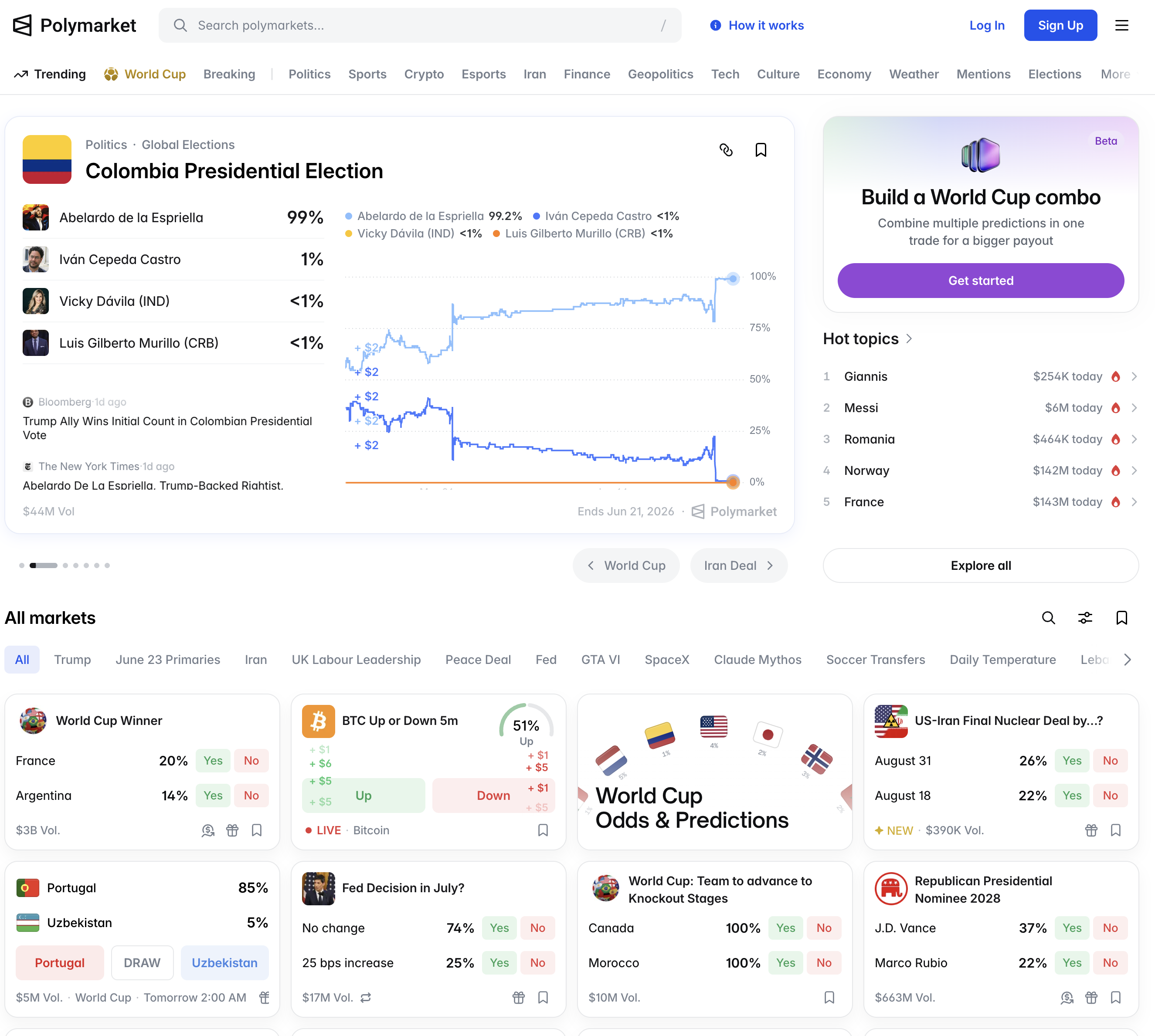
jun-19-verex.md. Reference UI:docs/images/verex-ui/homepage.png(Polymarket-style). (2026-06-23)
Task map
| # | Area | Status |
|—|——|——–|
| 1 | Basic Web UI — Kalshi-referenced, binary markets, real CTF contracts on anvil | ✅ built 2026-07-07 (shadcn UI + on-chain trading; see addendum 2) |
| 2 | Deploy to GCP + Cloud SQL DB + domain verex.jaylabs.xyz | ✅ complete — verex-api/verex-web live on Cloud Run, Cloud SQL wired, Sepolia trading live (chain decision resolved: (a) testnet); custom domain routed via Firebase Hosting (jul-25 5278191, prod routing jul-27 9921e23) |
| 3 | Portfolio page + market resolution (operator #0 as admin) | ✅ implemented + verified 2026-07-20 — details/jul-20-portfolio-resolution-design.md |
| 4 | Trade/resolution latency UX (chained on-chain txs feel slow on a real chain) | ✅ complete 2026-07-28 — #1 (demo-wallet pre-warming) + #2 (optimistic trade UI) done and verified live; leftover #3 (ResolvePanel optimism) and #4 (SSE) are superseded by the jul-28 async-settlement design (jul-28-verex-design.md Task C) — details/jul-22-trade-resolution-latency-ux.md |
| 5 | Per-environment contract isolation (separate backbone per local/test/production, not shared) | ✅ complete — separate test/prod backbones recorded in packages/contracts/deployments.json and enforced by the seed’s VEREX_DEPLOY_TARGET manifest + preflight; residual polish rides with future deploy work — details/jul-22-per-environment-contract-isolation.md |
Decisions (proposed — confirm)
| Topic | Proposed | Note |
|——-|———-|——|
| Web app | packages/web (Next.js 14, App Router) | existing scaffold (layout.tsx, page.tsx) |
| Data layer | DB-only → real CTF contracts (anvil) + DB mirror | superseded 2026-07-07 per jay: “use real contract for the market” |
| DB | Cloud SQL for PostgreSQL + Prisma | consistent with rabbit; verex has no DB yet |
| API | Next.js route handlers + Prisma in web | simplest for DB-only; alt = existing packages/api (Fastify) — open Q |
| Market type | Categorical (N outcomes; binary = N=2) | per spec |
| Domain | verex.jaylabs.xyz (subdomain) → Cloud Run | spec names this exact host |
| Deploy pattern | mirror rabbit scripts/deploy.sh (secrets → Secret Manager) | reuse known-good flow |
| UI kit | shadcn/ui + Tailwind | see Task 1 addendum — research + legal-risk notes |
💸 Cost: Cloud SQL bills monthly even when idle (~$8–10+ smallest tier).
Task 1 — Basic Web UI (prediction market)
Build a Polymarket-style UI driven entirely by the database (no contract integration yet).
Screens (from docs/images/verex-ui/homepage.png)
- Top nav: logo, search, “How it works”, Login/Sign-up (reuse Auth.js Google login).
- Category tabs: Trending, Politics, Sports, Crypto, … (from
Market.category). - Featured market (large card): title, categorical outcomes with % (implied probability), a probability-over-time chart, volume, close date.
- “All markets” grid: market cards — title, image/icon, top outcomes with %, volume.
- Sidebar: “Hot topics” list (by volume). (Nice-to-have; can defer.)
- Market detail page (
/market/[slug]): all outcomes + prices, chart, description, and a (mock) trade panel — buys recorded in the DB, no on-chain calls.
Data model (Prisma) — draft (review & adjust)
// prisma/schema.prisma
generator client { provider = "prisma-client-js" }
datasource db { provider = "postgresql"; url = env("DATABASE_URL") }

enum MarketStatus { OPEN  RESOLVED  CANCELLED }

model Market {
  id          String       @id @default(cuid())
  slug        String       @unique
  title       String
  description String?
  category    String?                              // "Politics","Sports","Crypto"…
  imageUrl    String?
  status      MarketStatus @default(OPEN)
  volume      Decimal      @default(0) @db.Decimal(20, 2)
  closesAt    DateTime?
  resolvedOutcomeId String?                         // winning outcome once RESOLVED
  createdAt   DateTime     @default(now())
  updatedAt   DateTime     @updatedAt
  outcomes    Outcome[]

  @@index([category, status])
}

model Outcome {
  id        String  @id @default(cuid())
  marketId  String
  market    Market  @relation(fields: [marketId], references: [id], onDelete: Cascade)
  label     String                                  // "Yes"/"No" or "Candidate A"…
  price     Decimal @db.Decimal(10, 6)               // implied probability 0..1
  sortOrder Int     @default(0)

  @@index([marketId])
}
Optional later: PricePoint (chart history), Position/Trade (mock trading per user).
Open: include mock trading in v1, or read-only display first?
To-do (who does what)
| You (jay) | Me (Claude) |
|—|—|
| Confirm API choice (Next.js routes vs packages/api) | Add Prisma + schema + migration |
| Confirm v1 scope: read-only vs mock trading | Build homepage (tabs, featured, grid) + market detail |
| Approve seed markets (how many / which categories) | Seed sample categorical markets to match the screenshot |
| | Wire list/detail API routes (DB-backed) |
Task 1 addendum — UI stack & design-similarity risk (2026-07-07)
UI stack: recommendation = shadcn/ui + Tailwind
Current packages/web is bare Next.js 14 (no Tailwind, no component lib, hand-rolled CSS) — the
source of the “awkward” look. Research summary (2026 landscape):
| Option | Fit for Verex | Verdict |
|---|---|---|
| shadcn/ui (+ Tailwind, Radix primitives) | De facto standard for Next.js; copy-in code you own (no dep lock-in) → full freedom to build our own visual identity; shadcn charts (Recharts) covers the probability chart; a11y from Radix |
✅ pick |
| Mantine | Batteries-included, strong for data-dense B2B dashboards; own styling system (not Tailwind) | good, but heavier identity to override |
| MUI | Enterprise breadth (data grid etc.) | Material look fights a Polymarket-style feed |
| HeroUI / daisyUI / Aceternity | lighter or animation-focused | not aimed at data-dense trading UI |
Why shadcn specifically for us: (1) 2026 trend is headless/Tailwind-first — shadcn is its center of gravity, best AI-tooling + ecosystem support; (2) copied-in source = we can diverge the theme tokens (colors/typography/radius) from both Polymarket and any prior work, which is exactly what the risk section below needs; (3) jay already knows it — lowest learning cost.
Implementation note: Task 1 build starts with tailwindcss + shadcn init in packages/web
(theme tokens defined once in globals.css), then the screens in the spec above.
Design-similarity legal risk (prior employer / Polymarket) — mitigation plan
Context: jay built a similar Polymarket-style UI with shadcn at a previous company; concern is a future claim that Verex copies that work. Not legal advice — framework + hygiene below; for real assurance have an IP/employment lawyer read the old employment contract.
How the law sees it (US frame; KR analog in parens):
- Copyright protects concrete code and specific graphic assets — not layouts, UX flows, or functional concepts. (KR 저작권법 similar: 아이디어/기능 배제.)
- Trade dress can protect overall “look and feel” but requires distinctiveness, non-functionality, and consumer confusion — a high bar for a functional, genre-standard prediction-market feed. (KR: 부정경쟁방지법 성과물 도용 조항(파목)이 가장 넓은 catch-all.)
- The realistic risk is therefore not “similar layout” but (a) reused code/assets and (b) employment-contract clauses (IP assignment, confidentiality, non-compete).
Mitigation checklist (do these; mostly already repo policy):
- Zero reuse: no code, components, Figma files, configs, seed copy, or screenshots from the previous company — clean-room rebuild only. (Using shadcn again is fine: MIT-licensed generic building blocks; a library choice isn’t ownable.)
- Differentiate identity from BOTH Polymarket and the prior project: own palette, typography, icon set, naming, copy — layout/density inspiration only, per README §2.2.6. One divergence step protects against both claim sources.
- Provenance trail: fresh git history +
docs/history/decision log (already the convention) shows independent creation with dates — the strongest practical defense. - Contract check (jay): reread prior employment contract for IP-assignment scope, confidentiality, and non-compete duration; that clause set — not UI similarity — decides the actual exposure. Lawyer review if any clause is broad or ambiguous.
- No confidential inputs: don’t consult the old product, its repo, internal docs, or metrics while building Verex screens; work from Polymarket’s public site + this spec only.
Sources: Untitled UI — React component libraries 2026 · Dualite — shadcn/MUI/Radix compared · C&C IP — UI/UX legal protection: trade dress vs copyright · Harvard — look & feel: copyright or trade dress · Proskauer — website trade dress claims
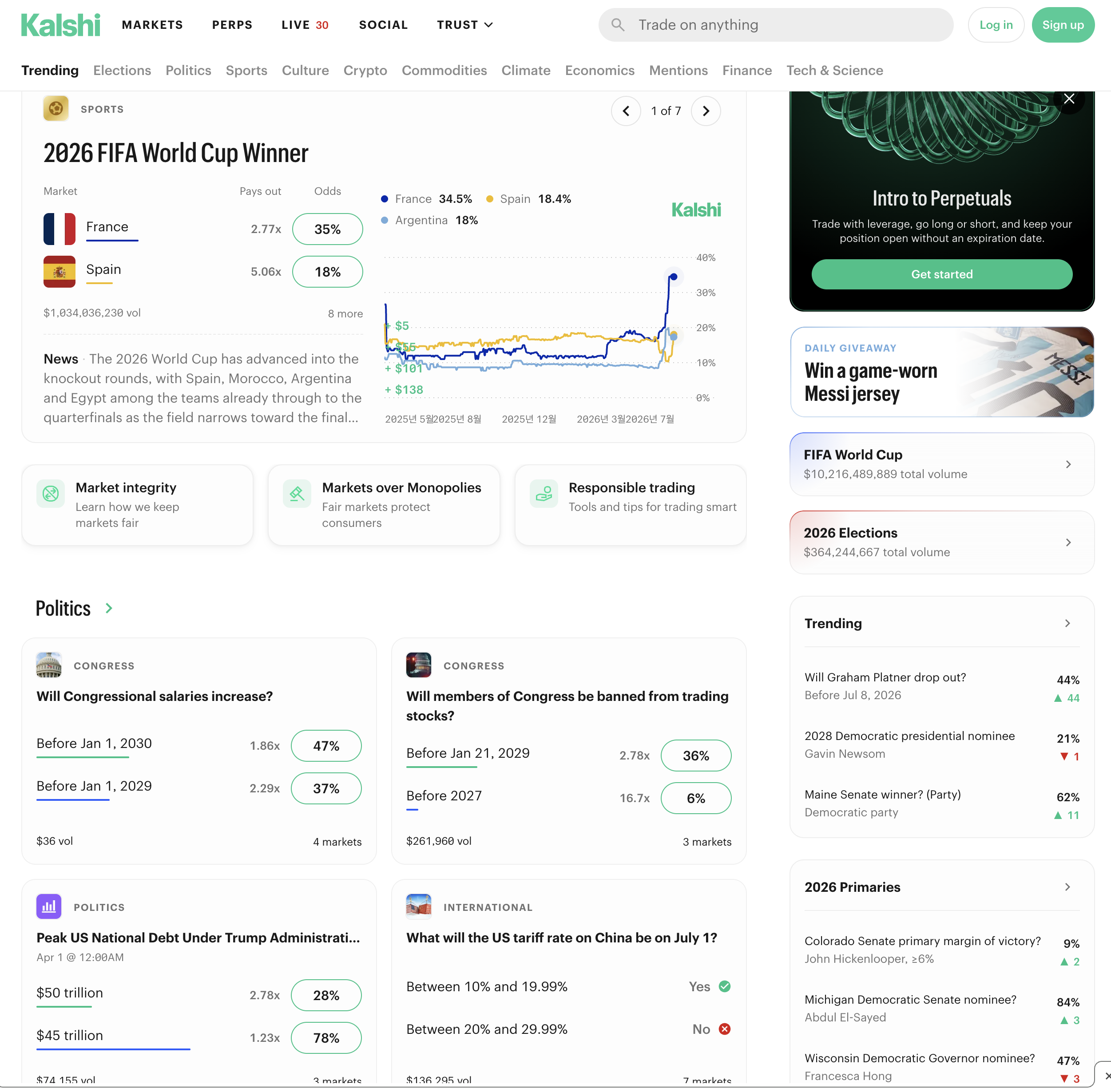
Main page UI
We can use this screen shots from Kalshi
1) Main page
Detail page UI
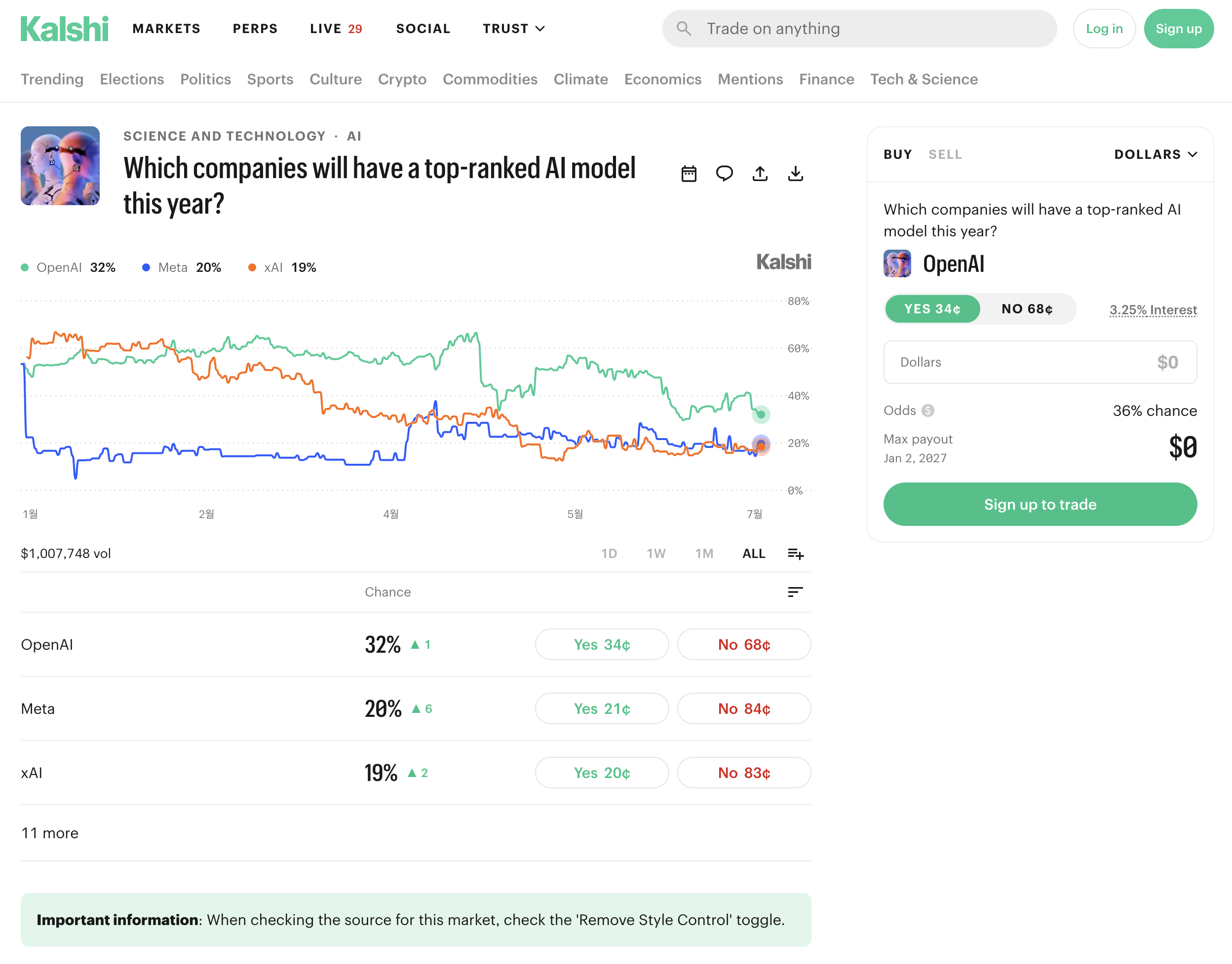
We can use this screen shot from Kalshi
 —
—
Task 1 addendum 2 — as built (2026-07-07)
Implemented on branch claude/deploy-export-log per jay’s “working version, complete features” directive:
- UI: Tailwind + shadcn (manual copy-in: button/card/badge/input/tabs/separator) with a distinct Verex identity (indigo primary, emerald Yes / rose No — NOT the Kalshi mint). Main page: nav (search + faucet + demo-wallet selector), category tabs, featured market with Recharts probability chart, market grid, hot-markets sidebar. Detail page: chart, outcome rows, rules + conditionId, recent activity, sticky Buy/Sell trade panel.
- Real contracts: every market is an on-chain CTF condition on anvil (seed deploys the
backbone via
DeployCTF.s.sol, thenprepareCondition→registerToken→ operator splits 10k USDC inventory per market). Addresses live in the DB (ChainConfig) — no env coordination. - Trading: every Buy/Sell is a real
CTFExchange.fillOrdertx — the user (demo anvil account 1–5, keys server-side) signs the maker order, the operator (account 0) fills from its inventory. Auto-faucet keeps the flow one-click. DB mirrors each fill: price impact (linear, L=2000 USDC), volume, trade log, chart point. Production wallet path (MetaMask → AA session keys) stays the S7 track. - Run locally:
anvil→pnpm --filter @verex/api db:reset(migrate + deploy + seed) →pnpm --filter @verex/api dev→pnpm --filter @verex/web dev.
Task 2 addendum — GCP setup summary (2026-07-07): jay’s actions vs Claude’s
⚠️ New decision needed first — where does the chain live in the cloud? Task 1 now trades
against anvil, which is local-only. Options for verex.jaylabs.xyz:
| Option | What it means | Trade-off |
|---|---|---|
| (a) Testnet (recommended) | Deploy CTF backbone to a public testnet (e.g. Base Sepolia); operator key in Secret Manager | Real public chain, demoable anywhere; needs faucet ETH + key management |
| (b) Hosted anvil | Run anvil in a Cloud Run/GCE container | Fast, but state resets on restart — toy-grade |
| (c) DB-only fallback | Cloud version reads DB, trading disabled (“local demo only” banner) | Cheapest; loses the headline feature in the cloud |
jay does (needs your accounts/access):
- Decide the chain option above (a/b/c) — blocks everything else.
- Pick the GCP project: reuse
doubletree-498007(rabbit) or create a new one; confirm billing is on. Be ready at the registrar→ almost nothing (updated 2026-07-07):jaylabs.xyz’s nameservers arens-cloud-e*.googledomains.com— the zone lives in Cloud DNS, so Claude can add theverexrecord viagcloud dns. jay’s only possible action: click Verify in Google Search Console if Cloud Run demands domain-ownership verification (Claude adds the TXT record; the verify click needs jay’s Google account).- If option (a): fund the operator address with testnet ETH (faucet) and approve storing its private key in Secret Manager.
- If Google login ships: add the production OAuth redirect URI in Google Cloud Console.
- Accept the standing cost: Cloud SQL smallest tier ≈ $8–10+/month even idle + Cloud Run per-use.
Claude does (scriptable, no jay input needed):
- Cloud SQL Postgres instance + database + user; run migrations; put
DATABASE_URLin Secret Manager. - Two Cloud Run services:
verex-api(Fastify — trading needs it in the cloud now) andverex-web(Next.js), withAPI_URLwired web→api. scripts/deploy.shmirroring rabbit’s shape (build → push secrets →gcloud run deploy --set-secrets).- Domain mapping
verex.jaylabs.xyz→verex-web; hand jay the DNS record to add. - If option (a): deploy
DeployCTF.s.solto the testnet, re-run the seed against it, store operator key in Secret Manager. - Smoke test in the cloud + history log entry.
Task 2 — Deploy to GCP + DB + domain (verex.jaylabs.xyz)
Plan
- Cloud SQL Postgres instance + DB + user;
DATABASE_URL→ Secret Manager. - Cloud Run deploy of
packages/web; connect to Cloud SQL. - Domain mapping
verex.jaylabs.xyz→ the Cloud Run service. - Reuse rabbit’s
deploy.shshape (push secrets to Secret Manager,--set-secrets).
To-do (who does what)
| You (jay) | Me (Claude) |
|—|—|
| Confirm billing enabled on the GCP project | Create Cloud SQL instance + DB + user |
| Edit DNS at the registrar — zone is on Cloud DNS; only click Verify in Search Console if prompted | Write verex/scripts/deploy.sh (mirror rabbit) |
| (DNS record itself: Claude adds via gcloud dns) | Run gcloud run domain-mappings create for verex.jaylabs.xyz + add the CNAME in Cloud DNS |
| Update OAuth redirect URI if login is used | Set AUTH_URL, push secrets, deploy |
Which GCP project for verex? Rabbit uses
doubletree-498007; reuse it or a separate project?
Delivery process (from the task’s “After the implementation”)
- Summarize what was done in
docs/history/(per verex convention). - Commit + push on a new branch
claude/<topic>. - Create a PR, then merge it — the task explicitly authorizes merging (this overrides the repo’s usual “leave the PR for jay” default, but I’ll still pause for your review first).
Open questions for jay
- API layer: Next.js route handlers (simplest) or the existing Fastify
packages/api? - v1 scope: read-only market display, or include mock trading (DB-recorded buys)?
- Auth: homepage public, login only for trading? (Auth.js Google login already scaffolded.)
- Seed data: how many sample categorical markets, and which categories?
- Chart: static seeded prices, or simulate price movement for the probability chart?
- GCP project: reuse
doubletree-498007or a separate project for verex? - Cloud SQL tier: smallest (shared-core) OK?
When ready
Say “go” and I’ll build everything on a single branch — claude/jun-19-verex
(Tasks 1 + 2 together) — pausing for review before any commit. Per the task’s
“after the implementation”: summarize in docs/history/, push, open a PR, then merge.